
UPS systems
Uninterruptible power supply
Power failures are not uncommon and can lead to data loss or life-threatening situations. UPS systems are ideal for protecting against this risk.
Secure price advantages as a B2B customer now!
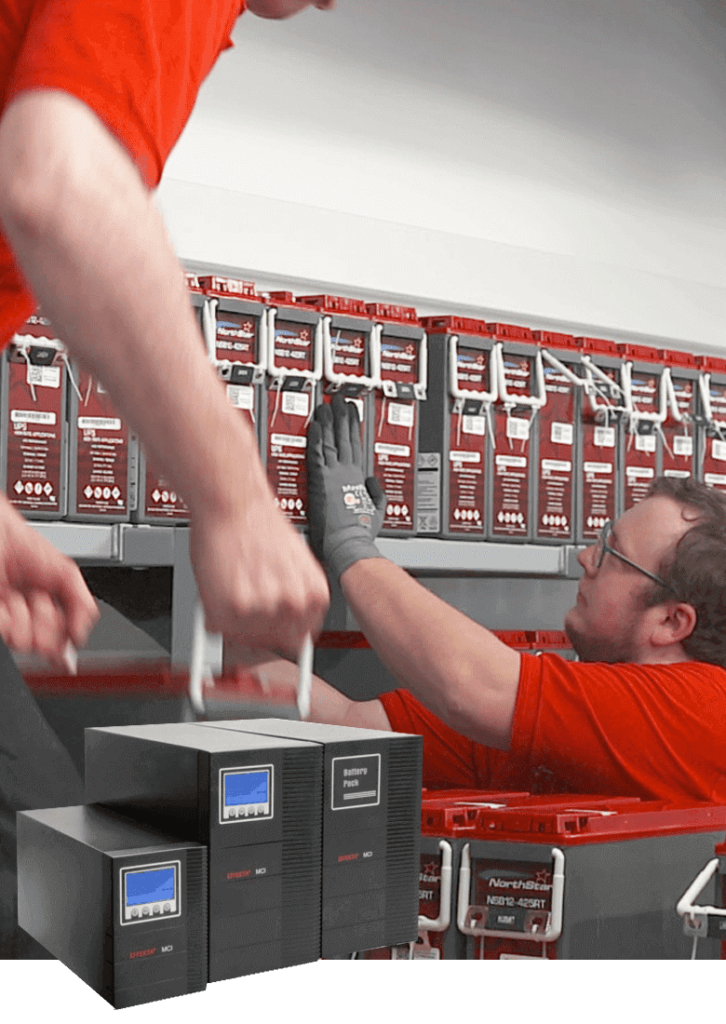
Our top brands for UPS system batteries


Installation and service of your UPS system
Our UPS service department is being transferred to an independent company. From now on, you will receive project planning, installation and maintenance of your battery systems, mains backup and emergency power systems in the usual quality from the experienced service team at MTN Service GmbH.
Contact:
Martin Tiews
info@mtn-service.gmbh
+49 172 433 57 73

UPS systems are essentially divided into three categories:
Provide protection against power failure, voltage dips and overvoltage. This type of UPS system offers the least protection, but at the same time is usually the most cost-effective variant. It is known as an offline or standby system, as the system only takes over the supply to the connected loads in the event of a power failure. The switching time often results in voltage dips of up to 10 ms. IT consumers, such as computers, can often compensate for this delay so that no power failure is noticeable at the consumer. These types of systems are therefore almost exclusively intended for computers or small IT devices that are not mission-critical consumers.
Provide additional protection against short circuits in the public network and line noise. The line-interactive system is regarded as an intermediate stage between offline and online technology. In contrast to the offline UPS system, systems of this classification also smooth the output voltage so that they also protect the connected loads against voltage peaks and line noise. These types of system are also suitable for protecting computers and, in some cases, server systems that are not mission-critical consumers.
Provide additional protection against high voltage peaks, frequency deviations, switching peaks and harmonics. UPS systems of the online classification provide optimum protection for your consumers and can be used for business-critical applications. Thanks to the double conversion technology, there is no voltage interruption in the event of a mains failure and the loads are permanently supplied. In addition, systems in this category also protect against various types of voltage disturbances. As the direct and Inverter When the UPS system is permanently in operation, a pure sine wave is generated so that an optimum power supply is permanently provided for your loads.
Frequently asked questions
You have questions about UPS systems?
What are the advantages of a UPS system?
There are several advantages for the user or operator when using UPS systems to protect the connected loads.
The first and most important advantage is the protection of the power supply for server landscapes, sensitive measurement electronics and all types of IT as well as cash register systems, for example. In the event of a power failure, not only is the loss of data, measurement results or the failure of complex systems prevented, it is even possible to continue working in the event of a power failure without interrupting the supply from the UPS system. A second advantage can also be, for example, to restore the „electrical imbalance“ of the house connection and the main building distribution to a symmetrical utilisation of the three phase conductors (L1, L2, L3) by the UPS system.
Is maintenance required for the UPS system?
Operator responsibility requires the operator of emergency power systems to carry out regular maintenance on electrical systems in accordance with DGUV V3. Proper maintenance should be seen as an investment in the future. No operator of an emergency power system wants a system that does not take over in the event of a power failure.
Maintenance work is therefore advisable to ensure the reliability and availability of your consumers even in the event of a power failure.
We recommend a maintenance interval of one year, which is also required by VDE 0105 for electrical systems and electrical equipment.
How long is the service life of the UPS and battery system?
A distinction is usually made between 5, 10 and 12 year batteries. However, these are expected service lives under optimum conditions.
Experience shows that often only 70-80% of this service life expectancy is achieved.
With UPS systems, regular maintenance is crucial for the service life of the system. With regular maintenance and the regular replacement of the necessary wearing parts, UPS systems can achieve a service life of >15 years.
How much space do I need for a UPS system?
This also depends on the load to be supplied and the desired/required bridging time.
Depending on the load to be supplied, standardised requirements may also play a role. In principle, however, every UPS system should be freely accessible and there must be sufficient wall clearance for ventilation. This also depends on the power of the UPS system.
Battery systems in particular are subject to standardised requirements due to the gases they emit during heavy charging.
Can I monitor the UPS system?
The majority of UPS systems can be equipped with additional network cards or fault messages so that they can be monitored via SNMP or connected to the BMS.
However, these monitoring devices are often not installed as standard in the UPS system.
How big is a UPS battery system?
Depending on the connected load and the desired bridging time, battery systems can be designed differently. Ideally, internal batteries installed in the housing of the UPS system are sufficient. In this case, the space requirement is minimal. However, with increasing requirements in terms of bridging time and load, it is often necessary to switch to external batteries which must be installed on a separate rack or in a separate battery cabinet.
How long is the bridging time of the UPS system?
The bridging time is directly dependent on the connected load and the installed battery system. The battery system for the UPS systems can vary from 1 kVA, so this cannot be answered in general terms.
What UPS power do I need?
The required UPS power is directly dependent on the connected loads and their load profile.
In order to correctly dimension the UPS system, the following information is required for the connected loads:
- Performance
- Cosphi
- Inrush current (overload behaviour)
Based on a corresponding load table, the maximum load current and the maximum peak inrush current can be calculated, which serves as the basis for UPS dimensioning.
We recommend a maximum utilisation of approx. 60% for all UPS systems to allow for growth and power reserves.
What types of UPS systems are there and which type do I need?
UPS systems are essentially divided into three categories:
- Offline / standby UPS systems of classification 3 according to IEC 62040-3: Provide protection against power failure, voltage dips and overvoltage. This type of UPS system offers the least protection, but at the same time is usually the most cost-effective variant. It is known as an offline or standby system, as the system only takes over the supply to the connected loads in the event of a power failure. The switching time often results in voltage dips of up to 10 ms. IT consumers, such as computers, can often compensate for this delay so that no power failure is noticeable at the consumer. These types of systems are therefore almost exclusively intended for computers or small IT devices that are not mission-critical consumers.
- Line-interactive UPS systems of classification 2 according to IEC 62040-3: Provide additional protection against short circuits in the public grid and line noise. The line-interactive system is regarded as an intermediate stage between offline and online technology. In contrast to offline UPS systems, systems of this classification also smooth the output voltage so that they also protect the connected loads against voltage peaks and line noise. These types of system are also suitable for protecting computers and, in some cases, server systems that are not mission-critical consumers.
- Online UPS systems of classification 1 according to IEC 62040-3: Provide additional protection against high voltage peaks, frequency deviations, switching peaks and harmonics. UPS systems of the online classification provide optimum protection for your consumers and can be used for business-critical applications. Thanks to the double conversion technology, there is no voltage interruption in the event of a mains failure and the loads are permanently supplied. In addition, systems in this category also protect against various types of voltage disturbances. As the rectifier and inverter of the UPS system are permanently in operation, a pure sine wave is generated so that an optimum voltage supply is permanently provided for your consumers.
What is a UPS system?
An uninterruptible power supply system (UPS for short) is used to supply emergency power to connected loads in the event of a power failure.
We will be happy to help you.